
Group LEadership
It's not about you
Remember that, it’s not about you! A critical rule for a facilitator to always remember is that this is the group’s experience and not the facilitator’s. Your role is to provide a safe environment for participants to experience growth and healthy reflection. Your role is to be a catalyst for change but for the experience to never become about you.
It is also important for the facilitator to realize that he/she cannot totally change, in a short period of time, the fears, lack of self-confidence, or dysfunction that have taken years to develop. The greatest opportunity will be to plant seeds in people in the hope that they will grow into healthy plants in the future. This is accomplished by providing safe, supportive, non-judgmental environment for the participants to move beyond their own personal expectations and limitations. The facilitator should not limit the group by giving them "the answer" to the activity. It is their responsibility instead to provide the environment within which the group or individual participant may succeed while leaving the outcome of success or failure to the participants.
Ethics on the course
One of our overall Critical moves is to maintain a Holistically Safe Environment - physically, emotionally, and spiritually safe for all guests.
An important part of facilitation is ensuring that we always earn the right to share and invest into the lives of the participants that we encounter on our course. If we engage in any activities that lack integrity then we will immediately erode any trust that has been built with the group. There are many areas where we need to be careful to remain above reproach when dealing with our participants. Some specific areas to be aware of are:
Always respect participant confidentiality, never sharing with others personal information about participants or what went on within a group that may be embarrassing or demeaning except as required by law. This also includes medical information that you may be aware of through a release form. This information should never be openly disclosed to the group unless the individual willfully chooses to share it.
As a facilitator, you must always work within your competencies, using only activities and elements that you’ve been trained to facilitate. This is extremely important in dealing with high activities. A facilitator should never lead a high activity in any manner differently from the way he/she has been trained.
Always remember “Challenge by Choice” (discussed in the section on Choice). Facilitators should understand that each participant is distinct in his/her physical and emotional abilities, and not expect each participant to be able to do the same things in every way as other members of the group.
If a person in your group has a disability, we will do or best to make accommodations to use activities and elements that make that person part of the group. There are many ways to adapt activities and elements. If a situation arises that you are uncertain about how to handle, speak with your Site Director.
Pre-Program Proccess
In order to facilitate a successful program for a group there is a lot of pre-work that is necessary. As a facilitator, you are typically not responsible to gather any information before a program begins, but it is helpful to be aware of the process that a typical group walks through prior to their arrival on site for a program.
Most groups will have a designated group leader who works alongside a Sojourn program designer to design the appropriate program for the day. The group leader and Sojourn program designer will work together to complete a full needs assessment for the group. This needs assessment includes the following information:
Details about the group (number of participants, ages, how well they know each other, previous ropes experience, contact info for leaders, physical or emotional limitations, etc..)
Details about group expectations (desired date, desired length of time, type of activities desired, spiritual content?, etc..)
Questions to identify purpose of the group (desired outcomes, fun vs. learning desired, what does success look like?, etc…)
In addition to this needs assessment process each participant in the group will fill out a medical release/waiver form. Each person must have a signed waiver prior to participation.
Sequencing your Day
Sequencing is an important skill in facilitating a quality program. Sojourn facilitators will often be given the group goals and a specific amount of time to lead activities. Sequencing is the term we use to describe the order of activities for a particular group. Our desire is always to use the most appropriate activities or elements in an orderly manner to meet the goals of the group. To know which activities and elements to use, the facilitator must be aware of what the group is trying to accomplish before the day begins and then assess the group as the day progresses. The facilitator is assessing the individual and the group’s physical abilities, readiness, and behavior then choosing appropriate activities in order to challenge the group. The sequence of desired activities is prepared ahead of time, but there is ongoing assessment and adjustment is throughout the entire program. A facilitator should always be ready to alter the plan if necessary to meet the needs of the group.
It is important to start with activities that are appropriate for the physical and emotional readiness of all participants. You never want to begin with the most difficult event of the day. By using an increasing level of difficulty as the session progresses a number of things happen:
The group is able to build more confidence by experiencing success at simpler tasks and work together towards more complex goals.
You, as the facilitator are able to assess the group and better chart a course to help them reach their goals.
You, as the facilitator gain trust from the group and may earn the right to encourage individuals to stretch themselves further.
A few tips on Sequencing:
Always have a written plan for what you expect will be best for the group given the needs/goals they expressed. Have your plan handy so you can reference this during the program.
Always have additional activities ready in case the group proceeds quicker than expected or in case you determine that an alternate activity could better suit their needs during the program. To do this well, it’s necessary to continually evaluate yourself, individuals in your group, the group as a whole, and the timing of your day to know how to best proceed.
Be ready to back off from your planned sequence in order to maintain the safety of the group. If the group is goofing off or not taking things seriously enough, then you should never proceed to riskier activities.
Begin with activities that minimize physical contact between the participants and slowly insert “closer-contact” activities as the day goes on. For example, don’t start with all-aboard, nitro crossing, TP shuffle, magic carpet, or similar activities unless the group already knows each other very well.
Until you’ve had an opportunity to observe the group in low impact situations and assess their readiness before moving to physically or emotionally challenging activities. For example, at the beginning of the program you should avoid activities that require lifting one another, blind folds, or other key emotional challenges.
Teach in Simplicity & Apply in Complexity – It’s ideal if you can teach your participants skills in simpler activities that they carry with them into more demanding activities. For example, if you help participants learn an effective way to communicate in 1 activity that they can recall and utilize in a subsequent activity, then they are learning from their past and reinforcing a new, positive behavior. Another example would be teaching participants to spot on something simple like the TP shuffle before requiring them to use that skill on something more complex like O.U.T. or the Team Wall.
A Reliable Sequencing Plan for most programs is…
Intro for the day
A Name Game and/or Fun Activity
Group Initiatives and Low Ropes (progressing in difficulty & processing throughout)
High Adventure Activities
Closing Debrief/Processing Session
Gradient
Our activity gradient scale comes from something called Flow Theory. This is a helpful tool to help recognize when the group may be ready for a more difficult challenge OR to scale back and participate in something easier.
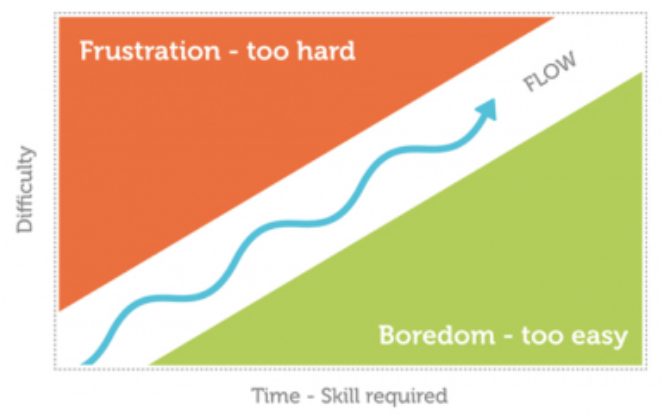
Gradient should be taken into account Physically, Emotionally, and Cognitively for groups. Examples of each area are:
Physical: Lifting other participants, climbing, swinging on ropes, etc….
Emotional: Blindfolds, Being asked to speak in front of group, pressure of failure. Anything that would require a participant to ask “Can they lift me?” “Will they drop me?” “Can I say this?”, etc..
Cognitive: Thinking, Planning, Decision making, Strategizing, etc…
It’s common that 2 or more of these challenges can be included in the same activity. Think about an activity like ‘Spiders Web’ or ‘OUT’ that involve problem solving (cognitive), the need to lift some individuals in the group (physical), and the emotional challenge some will face in being lifted up or with the possibility of causing harm to the entire team by making a personal mistake and touching a string.
When leading a group of participants and determining your ongoing sequence of activities, you must always be asking yourself “What is the appropriate level of challenge for this group to experience the growth that they need towards their desired outcomes?”
Success vs Failure:
The reality is that all activities will end in one of two places – Success or Failure. Both can be equally as valuable to an individual or group. As a facilitator, you never want to “set them up for failure” in order to prove a point, but it may be appropriate to give the group a challenge to strive for, uncertain of whether they will succeed or not. Sometimes the best thing for a group may be to induce stress as long as you also intend to create a safe environment to process that stress following the experience.
Keep in mind that that success and failure are moving the group towards different destinations – Success can be used to build confidence. Failure, if responded to properly, can be used to build endurance and resilience.
Building Trust with your group
Building trust in the relationship is your initial priority when a group arrives. Until individuals feel safe with you, they will not fully relax and maximize the opportunity. Assume that when a group arrives, there are likely many individuals who are already Outside of their personal comfort zone, so before we can encourage them to grow/stretch, we must first help them step INTO their comfort zone.
As participants arrive for the day, our critical move is “Lets G.O.E.!” (Greet, OBSERVE, Engage).
A few things that we are observing are “Who’s nervous to be here today?”, What are their expectations are for the day based on their behavior?” You are simply gathering data that you can use later in the day (if you already know that someone was nervous as they arrived, then you'll want to pay attention when you reach the high elements OR if you hear their voice early on and can recognize when it's different (shaky or high pitch, etc…), then it can raise your awareness of their emotional needs.
Display a Confident Demeanor
The facilitator should always display confidence and have solid knowledge of all elements they use, never practicing outside the boundaries of their competencies and industry standards. The group is looking to you as the expert, and it’s important that you maintain a confident posture throughout each program. Having said this, a facilitator should never attempt to operate in a manner that is outside the scope of their training and experience. If at any time you are put in a situation to lead an activity where you are not comfortable, it is your responsibility to talk to the site director to work out an alternative plan.
In addition to portraying confidence to participants with your own actions, it’s also important to maintain a unified front when working with other Sojourn staff. A facilitator should never question another staff member in front of the group unless an imminent safety concern is present. This can cause the group to doubt the facilitators and lose confidence in them and their knowledge. For instance, if a facilitator introducing an element leaves out an important safety piece, the co-facilitator should say “let me add ____” , rather than saying “you forgot ____”. It shows professional courtesy and good teamwork for facilitators to work together and build each other up in this way instead of cutting a fellow facilitator’s authority in front of the group. One exception to this rule is when there is an imminent safety concern present.
A facilitator’s primary responsibility is always to manage the risk for the group first and foremost.
Element Variation
In every game or activity there are 4 basic elements that provide the setting and structure:
1. People
2. Equipment
3. Environment/Location
4. Rules
If you change any of these 4 elements, you change the activity all together. (Example: A baseball game can be turned into a foreign activity if you run the bases backwards, play in a swimming pool, partner up with one partner blindfolded and the other with hands tied behind their back. What if you replace the ball for a rubber chicken?) The possibilities are endless if you are just creative and stay flexible to meet the needs of your group.
As the facilitator you are encouraged to change the way you facilitate games, group initiatives, and low ropes activities in order to meet the specific needs of the group. You should feel complete freedom to adjust the rules, goals, and parameters of each activity as long as you never compromise safety in doing so. Remember that your primary role as a facilitator is the risk management of the group, but as long as you are being safe then alter whatever is necessary to help the group accomplish their goals. Note – This is only true for low activities and not for high adventure activities. Facilitators should NEVER operate a high activity in any manner aside from the way they are trained.
Observe your group closely
During the Activity
As the activity is underway, your primary role is to observe what is occurring within the group. By doing so you are able to…
Manage the risk of the group to address any necessary issues. The physical readiness and make up of participants SHOULD influence the way you facilitate each activity as well as your decision making about additional activities. It’s important that you, as the facilitator perform ongoing assessments of yourself, individuals, the group, and the environment throughout the program.
By paying careful attention to individual’s responses and group interaction you are able to gain valuable insight to be used during the debriefing time following the activity. Below are few key tips that will help create an environment for healthy activities.
Keep participants engaged
In a typical group there will be a few people who choose not to participate in various activities for various reasons. Sometimes this may be based on a physical limitation and other times it is based on fear or another emotional barrier, but either way our desire to keep people engaged at some level. There are plenty of ways for individuals to play a supportive role on the course without having to dive off 40’ foot platforms in the trees. As we’ve explored, It is important to respect their choices and also to give them positions of usefulness in other areas.
Examples of how to keep people engaged include:
Low Activities - Spotting teammates, Giving verbal instructions, Encouraging teammates.
High Activities - holding the rope, anchoring a belayer, encouraging teammates, helping with harnesses/helmets.
Observations vs. Perceptions
As a facilitator it is good to get into the habit of sharing your observations with groups rather than your perceptions about those observations. There is a big difference. Observations are things that we actually see. Perceptions are things that we believe based on what we see. For example, most people are familiar with the trust fall activity where 1 participant falls backwards off an elevated platform into the arms of other group members. What if I were to ask you to share some observations about this activity from times where you’ve seen it before…. You might respond with things such as 1. “I’ve seen people get really scared”, 2. “I’ve observed some people getting distracted and losing focus during the activity”, or 3. “Sometimes people trust their group members a lot.” While all of those things MAY be true, none of them are things that you actually observe, but are instead your perception of things you’ve observed. Your actual observations about each would be 1. I’ve heard people say I’m afraid or I’ve seen them physically shaking before falling, 2. I’ve observed people looking away from the faller consistently, and 3. I’ve observed people stepping up and falling back very quickly or I’ve heard them say how fearful they were and yet they still fell into their teammates arms.
This may seem like a minor thing, but as a facilitator it’s important to recognize how our perceptions may plant seeds that were not originally present in the minds of those who hear. If I assert that someone was afraid or angry or frustrated when they were not, then I’m simply pushing my assumptions upon them even though it may not be true. This can subtly begin to erode the trust you have with group members.
As often as possible, make it a point to point out only your observations. If you perceive there is an issue behind the observation then you can begin to dig into that by asking questions rather than making assertions. For example, rather than saying “Bob, it seemed like you got really angry during that activity”. I might simply ask “Bob, I observed you getting very quiet half way through that last activity; can you tell me what you were thinking and feeling?” If Bob is willing to open up about his feelings then the same outcome that I was seeking may be obtained, but it’s been brought up from Bob himself which is both more helpful to the group and allows Bob to take ownership of his actions.
Something Strange or Wonderful
This is an excellent tool for any group. Often you will be faced with the problem of what to do if a player breaks a rule, falls off a beam, steps out of bounds, etc... It makes for some frustrating times if each time a mistake is made, the group has to start over again. ‘Something Strange or Wonderful’ allows you to be creative in “penalizing” those issues. This can be anything that you want it to be from blindfolding participants, to giving some participants opera voices, to giving someone a free pass to the end, to carrying a member through the game, etc… This fun little tool can serve to make activities more fun for your participants and also allow you to vary the difficulty level for the group in the middle of the activity. If they are doing really well and you need to make the activity more of a challenge, this is a way to do it. Likewise if they are really struggling and you feel that the group would benefit from experiencing some success then this is a great excuse to help them out.
Here are some Strange or Wonderful ideas:
Penalty Ideas
Speak in Opera Voice, or cowboy voice, pirate voice, etc…
Speak only in song lyrics or movie titles
Speak only in foreign language
Cannot Speak at all (1 person, multiple people, or whole group)
Can only use 1 arm or 1 leg
Blind (use a blindfold only if it’s safe)
One person or entire group starts over
Choose another group member(s) to receive a penalty
Carry another person through the activity
Two group members must stay connected for remainder of activity
Helpful Ideas
A penalty previously given is reversed
Someone reaches the end early
Give the group a hint about how to accomplish the objective of the activity
Penalized person chooses 1-2 other people to finish early
Remove a rule to make the activity easier for the group
Let them “earn” a benefit by saying something that would be beneficial to the group (memory verse, company mission statement, everyone else’s name, etc…)
If you have the time, another option is to prepare several “strange” and several “wonderful” things on cards before the day begins for participants to draw from a hat. This can be a great tool to illustrate that not all mistakes turn out to be bad. Occasionally, a mistake can lead to a wonderful discovery in life. Remember to debrief and talk about all the things that come up during these crazy scenarios!
After the Event
After each Sojourn program there are a few steps that take place. Some of these do not apply directly to facilitators but its helpful to be aware of what happens.
Our Post Program Critical Move is “E.N.D. Well”, so each staff will do their best to ensure that Everyone pitches in to complete all tasks, that the facility and equipment are left Neat, and that my experience is Documented in a Personal AAR. - Typically the first thing the staff will do after a program is pack away all the equipment used that day. Following this, all facilitators will gather to debrief the program. During this process each facilitator will grab a Personal AAR to fill out and hand into the Site Director for the day.
After the group debrief, the Site Director will fill out a Master AAR for the program. This report should document any notable issues from the day including actionable items for the course, anything necessary to follow up with the client, and a list of activities completed in case the same client returns in the future. Notes and rope logs from the personal AAR’s are included in this Master AAR.